The Seasonal Bit
Garage doors in this part of Maryland don't fail on a schedule, but they fail more in certain months, and the reason traces straight back to the housing stock. Most of the homes we work on went up between 1962 and 2007, with the median build year sitting around 1982. That means a big share of the torsion springs, openers, and track hardware we see are original or close to it - forty-plus-year-old steel that's been cycling up and down twice a day for decades.
When a spring finally lets go, it's usually in the cold months, not because the calendar matters but because cold steel is less forgiving steel. A spring that's been losing tension slowly for years will often hold through summer and snap the first hard-freeze week. If your door is original to a house built in the early 1980s, that's the part most likely to be the reason for the call, and it's worth having it checked before it picks the morning you're late for work to go.
What the Weather Here Does to It
This area sits in a climate band rated cold and severe, and that rating isn't decorative - it's the reason torsion springs here wear differently than they would somewhere mild. Steel contracts in the cold, and a spring that's already fatigued loses the last of its tension faster in a hard winter than it would sitting in a garage that never sees a freeze.
Cold also stiffens grease and lubricant on tracks and rollers, which is why a door that rolled smooth in August can start grinding or hesitating in January. It's not usually one dramatic failure - it's friction building up on hardware that was never lubricated for this kind of temperature swing. On a service call, that's one of the first things we're listening for: a labored motor sound or a door that stutters partway up, both of which point at cold-stiffened rollers and tracks rather than the opener itself.
One limitation worth saying plainly: cold doesn't cause everything. If a door was already misaligned or the springs were already past their rated cycle count, winter just exposes it faster. We'll tell you which one it is rather than blaming the weather for a part that was due regardless.
What to Look At First
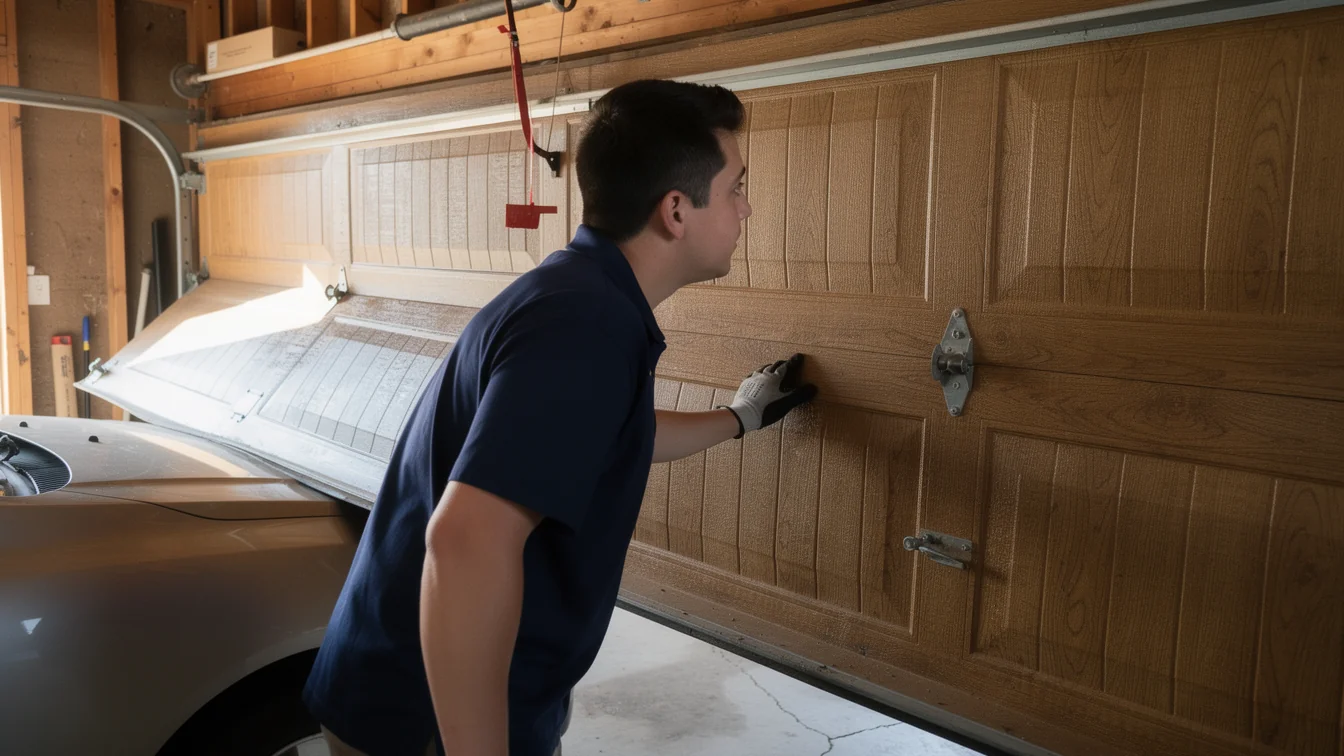
Given the age of the housing stock here, we start a service call in the same place almost every time: the spring and the track, because those are the two components most tied to a house's build year. A torsion spring on a house from the 1980s or 90s has likely seen tens of thousands of cycles, and the wear doesn't always look like a frayed cable - sometimes it's just a visibly stretched coil or a door that feels heavier lifting by hand than it should.
After the spring, we check track alignment, since decades of settling and seasonal ground movement can nudge brackets out of true without anyone noticing until the rollers start binding. Then the opener itself - logic boards in units from that same era are getting harder to source, which is a real limitation: if your opener is original to a house built around 1982, we may tell you a new unit costs less than hunting down a discontinued board.
We don't start with cosmetic stuff like panel dents or paint, not because it doesn't matter, but because on a house this age the moving parts are almost always the more urgent story.
What Is Going On
A service call here covers the diagnosis, not just the fix: we're figuring out whether what you're hearing or seeing is the spring, the track, the opener, or some combination, and we tell you which one before any work starts. We cover the towns around Waldorf out to about Owings, eighteen miles off, and La Plata, five miles the other direction, so the trucks are moving through a mix of housing ages all day, not just one neighborhood's problems.
Across the service area there are roughly 109,568 households and about 59,424 owner-occupied houses - that installed base is what shapes which parts we carry on the truck, since most of it dates to the same general building window. With a median household income of $115,562 across the area, a lot of owners we see opt for a full opener swap once the logic board on a twenty-year-old unit fails, rather than chase a part that's hard to find.
What we're not doing on a standard call is a full door replacement estimate unless you ask for one - that's a separate conversation with different pricing, and we won't fold it into a repair visit unless the repair genuinely isn't worth doing.
Talk to a local pro
Garage door trouble in Waldorf?
Same-day service with honest, upfront quotes.